

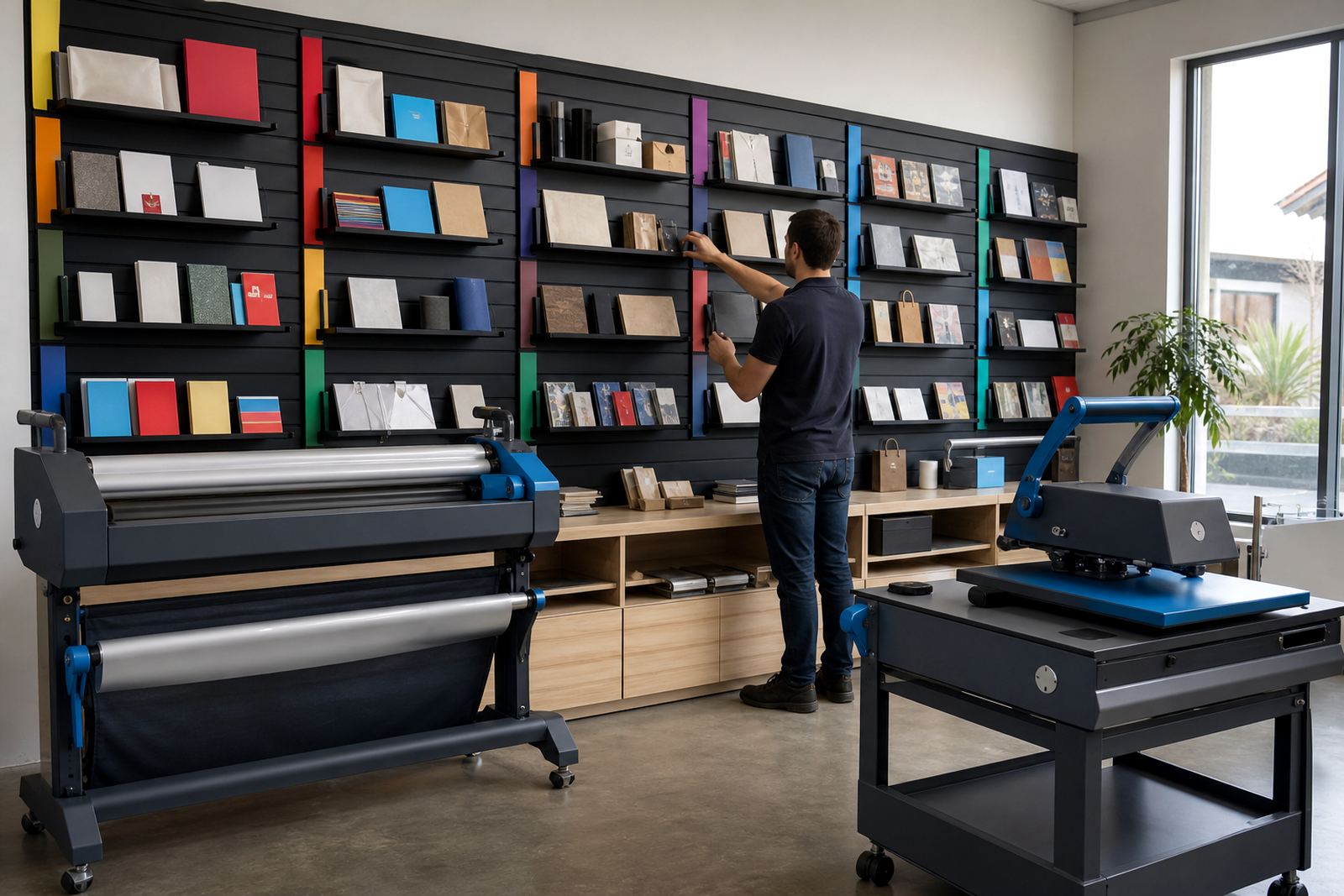
Adding new products without upsetting the live catalogue
Catalogue expansion covers the next round of products after launch, from one extra line to a fuller range spread across departments or branches. The work is handled in structured phases so the live store keeps moving while new items are prepared, checked and published.
That can include new business cards, labels, presentation folders, signage, apparel print items, packaging, books, forms or corporate stationery. We map each product to its sizes, variants, finish options, file rules and production path before it goes live. The aim is not to stuff the store with half-finished options, but to add items that sales staff and customers can order with less confusion.
- New product pages with size and finish selections
- Variant rules for colour, quantity, substrate or binding
- Artwork fields matched to the correct print method
- Delivery zones and collection options where needed
- Production notes for internal handover
What we set up inside each added product
Each item in our catalogue needs fuller detail than a title and image. We build the logic behind the page so the pricing, file submission and proofing steps line up with how the job will be produced. If a product needs trim size, bleed, folded size or a finish choice, those details are built into the order flow instead of sitting in a separate note.
The same applies to price matrices. A new item may need pricing by size, quantity, paper type, print sides, colour count or turnaround band. Where a quote-based item works better than instant pricing, we can set the page to collect the right details and route the order into a controlled quoting step. That gives the team cleaner briefs and fewer back-and-forth corrections.
- Price matrix setup for quantities and product variants
- Artwork rules for bleed, safe area and file type
- Proofing steps for approval before production
- Order status labels for internal production tracking
- Optional payment and courier logic for the item
Phase-by-phase rollout for a growing catalogue
We usually split expansion into smaller groups so the store does not become crowded or inconsistent. Some shops start with a single family of products, then add another group once the first set is settled in production. Others need a wider roll-out across several branches or sales channels, and the build is planned around that structure.
The sequence depends on product complexity, stock handling and the amount of artwork variation involved. A standard product with fixed sizes can move faster through the build than a product with many finishes, custom dimensions and multiple proofing paths. We keep the order of work practical: define the range, build the template, test the maths, check the artwork logic, then publish.
- Product scoping and naming structure
- Template build and pricing logic
- Test orders through the storefront
- Staff walkthrough on ordering steps
- Launch into the live catalogue
Artwork rules and proofing for repeatable jobs
Expanded catalogues often expose weak points in artwork handling. A customer may upload the wrong file size, miss the bleed, or place text too close to the trim. We set up artwork rules so the product page asks for the right files and flags the common trouble spots before the job reaches production.
For products that need proofing, we configure approval steps that fit the way your team works. Some items need a visual proof before print, while others only need a file check for size and format. We can also shape the workflow for items that move through different departments, especially where the catalogue includes both digital print and larger format work.
- Artwork upload fields per product type
- File checks for size, format and resolution
- Proofing workflow setup where approval is required
- Internal notes for preflight checks
- Separate handling for print, finish and dispatch stages
How the work is priced
Catalogue expansion is priced according to the size of the added range and the amount of build work behind it. A product with a simple template and one price table takes less effort than a product with multiple sizes, rule-based pricing, artwork variations and delivery logic. We look at the product family, not just the number of pages.
For larger ranges, the work is often handled in batches so the budget matches the rollout. That keeps the scope clear when a shop wants to add a few lines now and a wider set later. If a corporate portal needs the same new product list mirrored for a specific client, that can be included in the scope as well. Pricing is quoted as a project, not as a blanket rate, because the build effort changes from one catalogue to the next.
Aftercare once the new range is live
After a new product is published, the team usually needs a short settling period to make sure the order data, proofing steps and production handover are all behaving as planned. We stay available for adjustments to labels, pricing rules, artwork prompts or product text where the live use reveals a gap. That work is practical and tied to how the store is actually being used.
If a product needs a second phase later, such as extra finishes, a new size band or a branch-specific variation, it can be added without rebuilding the whole catalogue. We also help train staff members who will be handling the new product so the ordering path, notes and proof approval steps are understood before the volume starts to build.
- Post-launch fixes to product logic
- Small edits to artwork prompts and labels
- Staff refresher training on the added range
- Branch-specific variations where required
- Support for future range growth
Key facts
| Service area | Durbanville, Cape Town, and buyers across South Africa |
|---|---|
| Best for | Print shops adding new products after storefront launch |
| Build type | Product templates, price matrices, artwork rules and proofing flows |
| Typical scope | New SKUs, variant logic, portal sync and delivery settings |
| Implementation method | Phased rollout with testing before publication |
| Base location | Durbanville, Cape Town |