

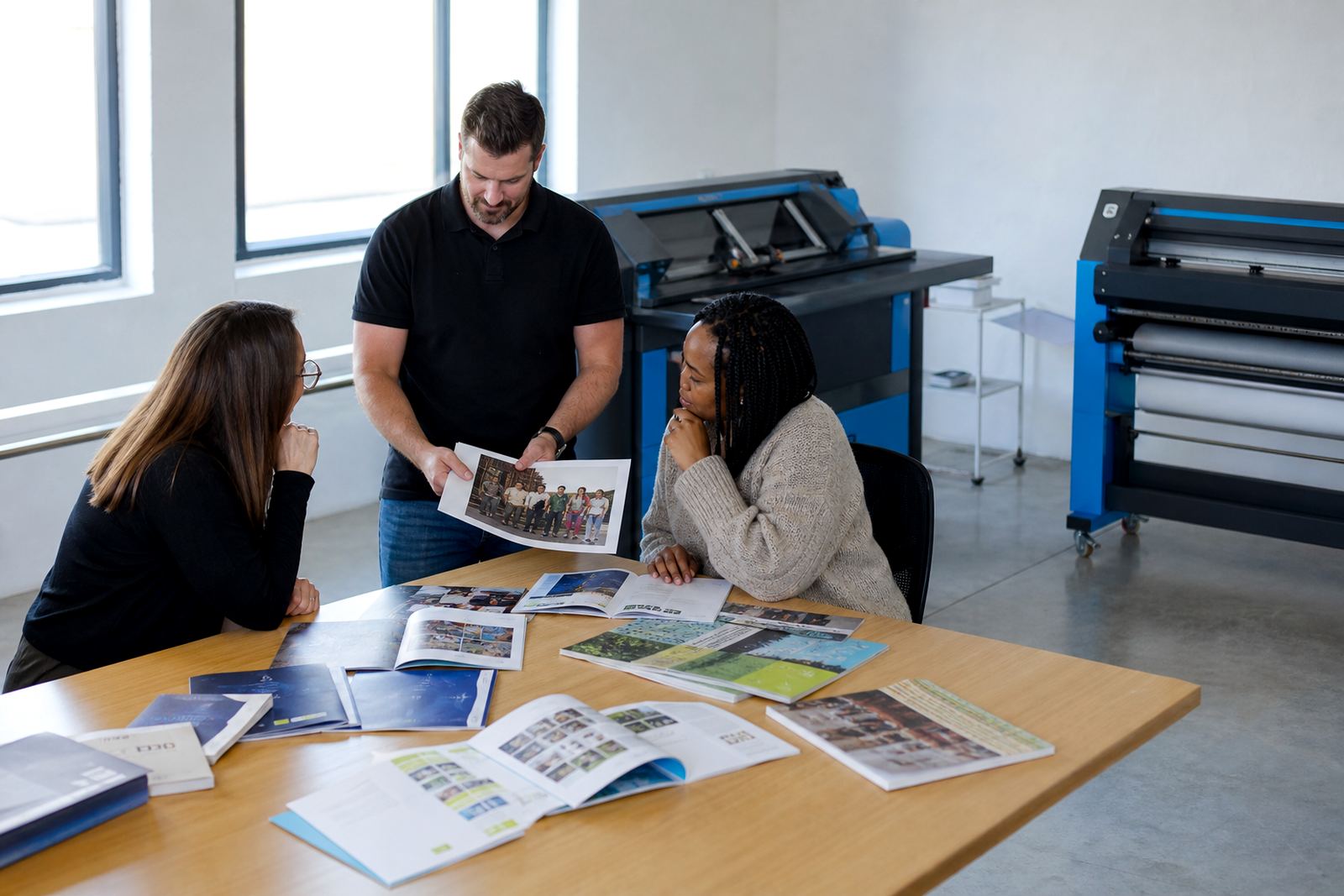
A school catalogue that could carry term-time pressure
The client was a school-facing print operation in Randburg that handled enrolment packs, notice items, sports days, fundraisers and year-end stationery runs. The old ordering method left too much room for wrong versions, missing artwork and last minute changes from parents, staff and committee members. The brief was to move those jobs into a single storefront where the right item, price and artwork rules sat in one place.
We mapped the common school items first, then separated them into categories that made sense for admin staff and production staff alike. Forms needed clear fields and fixed artwork areas. Event collateral needed seasonal visibility. Repeat items needed locked specifications so a second order did not drift from the first.
Build choices shaped by real school admin
The store had to work for multiple people, not just one buyer. Some orders were placed by office staff, others by fundraising committees and a few by sports coordinators who only needed a small batch. That meant the product builder had to be direct, with short option sets and price matrices that changed cleanly by quantity, size and paper choice.
- Product templates for forms, newsletters, folders and event posters
- Artwork upload with preflight checks for missing fonts, image quality and trim safety
- Price rules that adjusted by quantity and finish without manual recalculation
- Account-style ordering for repeat school buyers and approved staff members
We also set up proofing steps that suited a school environment. Some items needed a simple approve or reject flow. Others needed a few rounds of text correction where names, dates and venue details changed after the first draft. The system had to keep those versions neat, because school work can shift fast when a calendar changes or a venue moves.
Artwork rules for forms, notices and event collateral
Forms were the strictest part of the build. They needed exact wording, space for signatures and clear areas for school logos, contact details and grading notes. We added artwork rules that flagged low-resolution files, off-size pages and layouts that pushed important text too close to the edge. That cut down on avoidable rework and made production handover cleaner.
Event collateral asked for a different treatment. Colour posters, sports sheets and fund-raising handouts were allowed more visual variation, but they still needed sensible crop marks and the right paper options for indoor or outdoor use. Seasonal ordering was built into the catalogue so the same school could move from orientation packs to sports day print runs without rebuilding the whole store.
- Artwork preflight for size, bleed and image quality
- Proof approval notes stored against each order
- Separate rules for fixed forms and flexible event print
- Reusable templates for terms, dates and school-specific fields
Four weeks of setup, checking and training
The project ran over four weeks from mapping to launch support. Week one focused on product structure and the main buying paths. Week two covered template build and pricing logic. Week three dealt with proofing flow, admin settings and delivery choices. Week four was used for staff training, content checks and launch support with the client team.
Training had to respect different roles. The admin team needed to know how to read orders, update status and handle repeat jobs without changing the wrong settings. The production team needed clearer notes on artwork quality and print readiness. We kept the process practical and used real school job examples, not abstract screen tours.
- Setup workshop with the office team
- Template review for standard school print items
- Admin training on order handling and status updates
- Production handover on proofs, artwork and job notes
What changed once the store was in use
After launch, the biggest shift was order consistency. School buyers no longer had to explain the same layout details for every repeat print run, and production staff had fewer gaps to chase. The catalogue made seasonal ordering easier, because a buyer could move from one school function to the next without rebuilding artwork instructions from scratch.
The tracking view also helped when several jobs were live at once. A notice order, a sports day pack and a term-end item could each be followed through proofing, approval and production without mixing up the status notes. That mattered in a school setting where one late form can hold up a whole batch.
The result was a tidier process for recurring work. Fewer corrections landed late in the job, and the office team had a clearer path for ordering the same item in a new term or a new season. It was not about making the work flashy. It was about making sure the right school item was the one that got printed.
The parts we would keep for a similar school build
The strongest part of this project was the separation between fixed items and flexible seasonal items. That split kept the school catalogue readable and let pricing behave properly across very different product types. We would use that approach again on any school setup that carries forms, events and repeat annual items.
We would also keep the proofing structure tight. Schools often work with shifting dates, leadership changes and more than one person signing off on content, so a neat proof trail helps more than a loose message chain ever will. In this build, the order trail and the artwork trail stayed close together, which made the whole process easier to manage.
- Keep forms locked and event collateral more flexible
- Use reusable templates for annual school ordering
- Build proofing around approvals, not informal chat threads
- Separate admin tasks from production notes from the start
For a school supplier operation, that structure is practical. It reduces confusion at the front end and keeps the job moving through the shop with fewer small mistakes. That was the point of the Randburg setup and it is the part most likely to hold up on future school work too.
Key facts
| Client type | School print supplier operation |
|---|---|
| Town | Randburg |
| Core build | Web-to-print storefront with product builders and tracked ordering |
| Main items | Forms, event collateral and seasonal reorders |
| Project timeline | 4 weeks from mapping to launch support |
| Base team | Durbanville, Cape Town |
| Staff involved | Pieter van Zyl, Ayanda Nortje, Johan Kotze, Naledi Ebrahim, Ridwaan Adams, Bianca Daniels |


