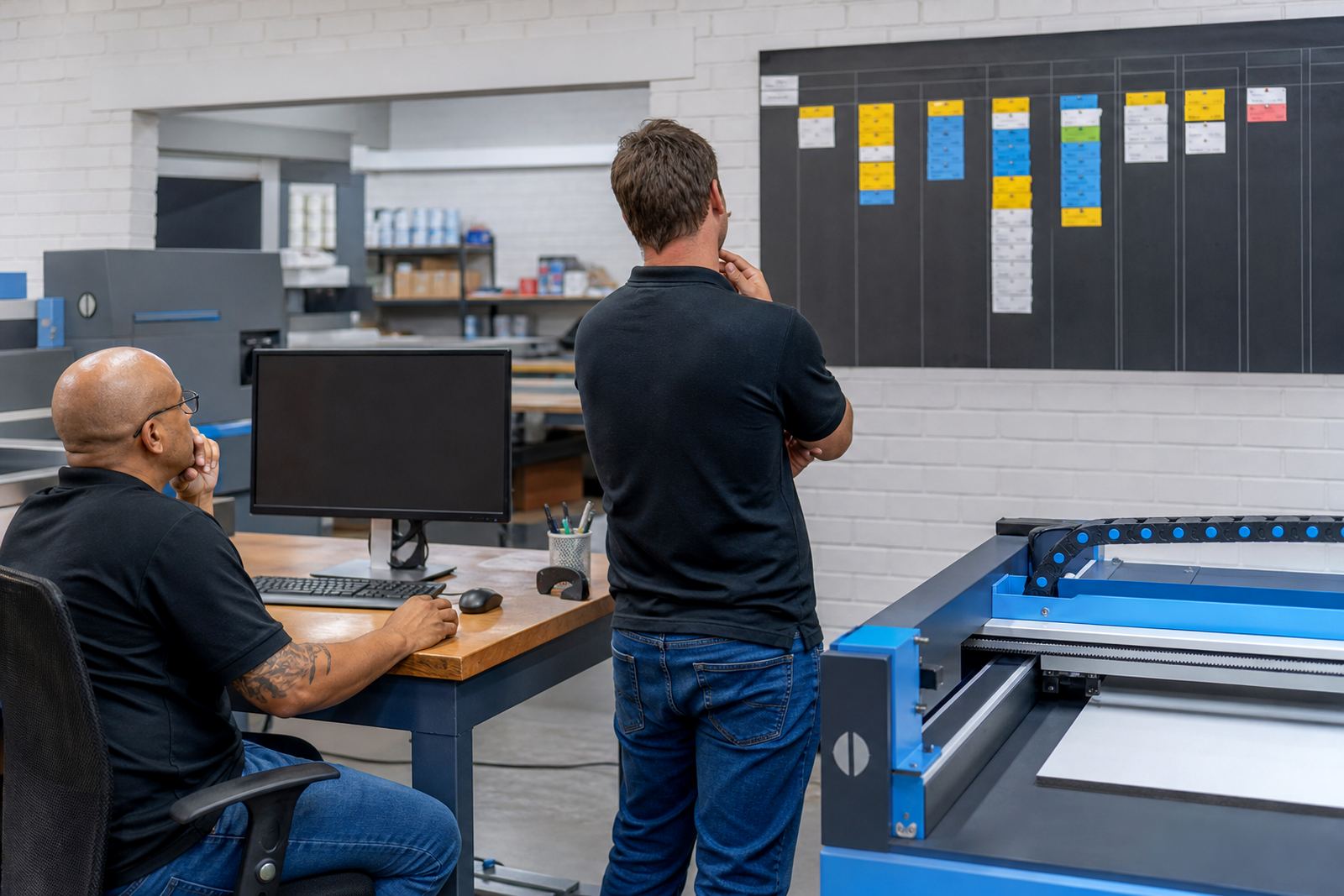


Private reseller access without the open shop feel
The client handled trade work for a mix of resale accounts, and the old order path left too much room for back-and-forth on sizes, finishes and proof approvals. The brief was to give approved buyers a private ordering space, while keeping pricing rules controlled and making each new order less dependent on manual handovers.
Bellville sits close to a lot of commercial traffic, so the ordering flow had to suit busy buyers who already knew what they wanted. We built the storefront around account-based access, product selection by use case and a cleaner route from quote to payment or account billing where that was required.
- Private portal access for approved reseller accounts
- Repeat-order shortcuts for common products and reorders
- Controlled product visibility by customer group
- Order notes and internal handling instructions attached to each job
Artwork intake that does not bury the print room
The second part of the brief was artwork handling. The shop needed file upload points, clearer instructions for bleed and safe areas, plus a way to flag low-resolution artwork before it reached production. We mapped artwork rules into the product pages so buyers could see the requirements before they placed an order.
For the production side, we set up proofing steps that matched the way the team worked. Some jobs needed a quick visual check, while others needed a formal approval trail before print. That split reduced confusion, especially on repeat work where small artwork changes can cause bigger problems than the client expects.
- Artwork upload fields per product and size option
- Preflight checks for image resolution and file type issues
- Proof approval steps for selected job types
- Instruction fields for cutters, press operators and finishing staff
Price matrices that stay steady across formats
Pricing was handled with a matrix structure so the client could price by size, quantity, stock type and finish without rebuilding the same quote every time. Trade printers often need layered pricing, because a label run, a folded leaflet and a presentation folder do not behave the same in production or in margin control.
We built the matrix rules to cover common combinations and to keep the online price visible enough for the buyer, while still leaving room for internal settings on unusual jobs. The result was a cleaner quoting path for resellers in Bellville and for corporate buyers further afield in Cape Town, Johannesburg and Pretoria.
- Quantity breaks tied to product templates
- Finish and stock selections linked to price logic
- Set-up for variable artwork and repeat-run pricing
- Separate handling for account customers and upfront payers
Weeks on the calendar and the order of work
The rollout ran over six weeks. The first week was discovery, where we mapped the customer groups, product families and the handoff points inside the shop. In the second and third weeks, we built the core templates, pricing tables and artwork rules. The fourth week focused on proofing workflows and order statuses, while the fifth covered staff training and test orders. The final week was used for launch support and practical fixes from live use.
That schedule suited a trade printer because every stage affected the next one. If the product template is vague, the artwork team feels it. If the pricing matrix is loose, the quote counter gets noise. If order statuses are not clear, production has to guess which job is ready and which one still needs approval.
- Week 1: workflow review and product mapping
- Weeks 2 to 3: template build and pricing setup
- Week 4: proofing and order status configuration
- Weeks 5 to 6: training, launch support and adjustments
Training that matched the people using the system
We did not treat the setup as only a software job. The admin team needed to know how to update products, check pricing rules and move orders through production. Sales staff needed a cleaner way to manage reseller access and special requests. The training sessions were split by role, so each group saw only the parts they handled every day.
Ayanda Nortje led implementation, Johan Kotze handled the template structure, Naledi Ebrahim guided the training sessions and Ridwaan Adams handled support once the site was live. Bianca Daniels kept client communication tight around the rollout, while Pieter van Zyl oversaw the overall direction and the final workflow decisions.
- Admin training for product edits and order handling
- Staff training for approvals, notes and customer queries
- Workflow review for production handover points
- Client-side guidance for reseller portal use
What changed once the portal went live
After launch, the client had a more organised route for private reseller orders and fewer loose instructions moving through our contact form or phone calls. Repeat buyers could use saved product paths instead of starting from scratch, and the production team had a clearer record of what was ordered, approved and queued for the floor.
The stronger part of the result was not only speed, it was control. Artwork rules sat with the product, pricing sat with the matrix and job tracking sat with the order record. That made it easier for the Bellville team to manage trade work across Cape Town and further branches without each order needing a fresh explanation.
- Cleaner repeat ordering for approved reseller accounts
- More structured artwork intake and proof handling
- Better visibility from order placement through production
- Less manual retyping of product details and job notes
The parts we would carry into the next rollout
We would use the same order structure for any trade printer that relies on private buyer groups, repeat work and artwork control. The strongest pattern was the link between product templates and production rules. When those two pieces line up, the shop spends less time untangling orders and more time moving jobs.
For a similar rollout, we would keep the product set tight at launch, then expand the catalogue once the live jobs are moving cleanly. That keeps the system manageable for staff in Bellville, and it gives the client a steadier base for adding new products, new buyers and new account rules without cluttering the first release.
- Start with the core trade products first
- Keep artwork rules visible on each template
- Build the matrix around real production steps
- Add catalogue extensions after live use settles
Key facts
| Project type | Web-to-print storefront rollout for a Bellville trade printer |
|---|---|
| Core functions | Private reseller access, repeat ordering, artwork upload and proofing |
| Pricing setup | Price matrices by size, quantity, stock and finish |
| Workflow scope | Artwork rules, approval steps, order tracking and production handoff |
| Delivery period | 6 weeks from discovery to launch support |
| Service areas | Bellville, Durbanville, Cape Town, Johannesburg, Pretoria and Durban |