
NCR book orders that behave like a proper print job
NCR books need more than a product name and a price. The online order must hold the set structure, the copy colour order, the numbering sequence and the finishing details so the shop can move straight into production without rewriting the brief. That is where product builders and artwork rules matter, because NCR books often vary by sets, slips, pad counts and binding style.
For South African print shops, these orders usually cover duplicate or triplicate sets for invoices, delivery notes, receipt books, job cards and internal control forms. Some clients need serial numbering on every set, some want a different starting number on each pad, and some need the number position fixed so it lands clear of the perforation. A clean storefront flow keeps all of that in one place.
PrintEngine supports NCR book products as configured items rather than loose quote requests, so the customer chooses the structure, uploads artwork where needed and sees the correct price matrix for the chosen spec. That makes it easier to handle standard pads and more technical custom runs on the same system.
- Set counts: duplicate, triplicate or more where required
- Numbering: sequential, pad-based or customer-supplied ranges
- Binding: glued pads, stapled sets or stitched book style
- Finishing: perforation, drilling and tear-off slips
Sizes, set counts and finishing choices people actually ask for
The size range for NCR books usually starts with compact office formats and moves through common commercial sizes. A5 suits small order pads and receipt books, A4 works well for job cards and delivery paperwork, and custom trimmed sizes help when a client wants a form to fit a filing tray or a vehicle box. The storefront should show these clearly, not hide them under a single generic option.
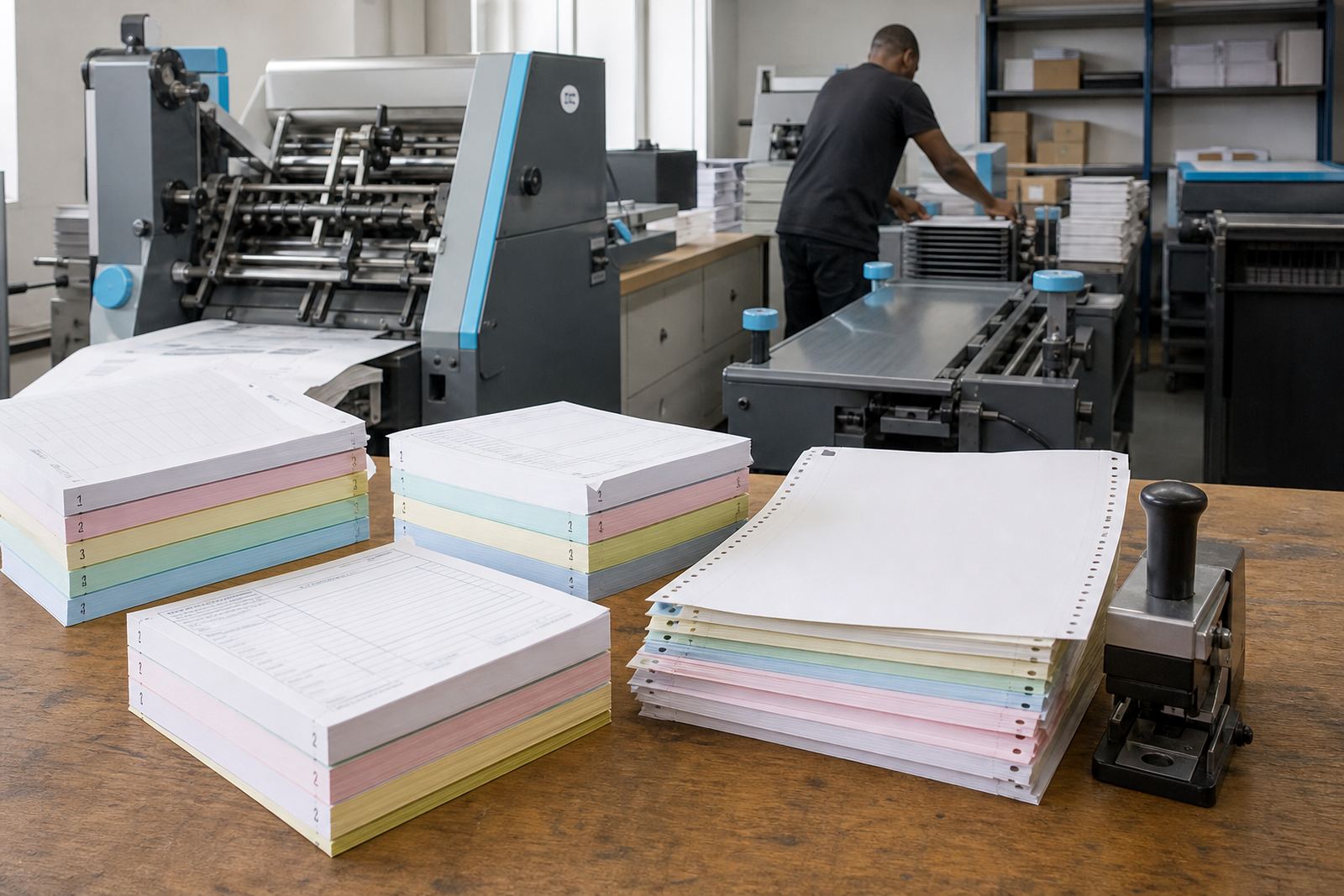
Paper choice matters too. NCR stock is sold by sheet build and colour sequence, often with white, yellow, pink or green copies arranged to keep the original and duplicates easy to separate. A good setup also allows back printing, loose numbering, card inserts where needed and perforation across the tear-off section. Where a business needs a hard cover or a wraparound spine strip, that detail needs to sit in the product build from the start.
Many buyers want the same form in more than one size or with a different count per book. A builder can present those variants as clear choices, so a customer in Cape Town or Johannesburg does not need to guess which option covers their use case. That reduces the back-and-forth around basic spec details and helps the production team keep the right stock and finishing plan in view.
- Common formats: A6, A5, A4 and custom trimmed sizes
- Copy sequence: 2-part, 3-part or 4-part sets
- Finish options: perforated, numbered, padded, stitched or loose
- Artwork input: supplied PDF, editable form, or older layout for update
Where NCR books fit into daily work
NCR books are used where a paper trail still matters. That includes workshops, wholesalers, courier depots, building suppliers, small retail counters, field service teams and office admin counters that need duplicate proof of handover or sign-off. They also work well for companies that still want printed controls alongside digital admin, especially when stock moves between branches or drivers and the receiving copy must stay legible.
For this trade, the software has to handle a practical mix of public and private ordering. A walk-in customer may need a straightforward pad of 20 books, while a corporate buyer may need branded books with a locked layout, site-specific numbering and a controlled re-order path. A B2B portal helps there, because the company can keep its approved spec in one place and avoid re-entering the same details every time.
Order tracking also matters once the job has moved out of the quote stage. If the product is built with live status stages, the customer and internal team can see when artwork is waiting, when approval is done and when the job is moving through production. That is useful for NCR books because the print, numbering and binding steps are often tied together in a tight sequence.
- Good fit for job cards, invoices, receipts and delivery notes
- Useful for branches that need one approved layout across sites
- Works for both one-off orders and repeat corporate supply
- Supports ordered reprints with the same spec and numbering rules
Artwork, numbering and proofing without loose ends
NCR book artwork needs a steadier workflow than a poster or flyer. The layout often includes logos, form fields, sequential numbers, carbon copy notes and fine rules that must line up across every part of the set. Artwork preflight helps catch image quality, bleed, trim and text placement issues before the job is released, which matters when a small shift can spoil a perforation line or cut off a number box.
Proofing workflows should be built for approval and revision, not casual browsing. A customer may need to check spelling, field labels, number start points and whether the copy colour sequence is correct. For shops working across Durban, Pretoria and Bloemfontein, a controlled proof trail prevents small errors from reaching press.
When a storefront includes template build support, the product page can carry a form structure that is already aligned to print practice. That means fields for company name, contact person, set count, number start, paper sequence, binding type and whether the books need perforation at one or more positions. Those are the details that keep the job true to the press sheet.
- Artwork checks: bleed, trim, fonts, image quality and field alignment
- Proof points: numbering position, copy count and perforation line
- Template fields: branding, contact details and form instructions
- Approval flow: review, amend and release stages
Setup and production handover for the print floor
NCR books only work properly online when the product setup mirrors how the shop produces them. That means the store needs a template that speaks the same language as the bindery and finishing team. If the books are padded, the build should ask for pad count and set count. If they are numbered, it should capture the number range and whether numbering repeats across books or continues through the order. If the forms need perforation, the tear-off position must be specified before the run starts.
PrintEngine supports that kind of setup with storefront configuration, product templates, price matrix setup and workflow review. For shops in Durbanville and across South Africa, the practical aim is to get the customer order into a format the admin team can price, approve and send through production without retyping the same instructions. Staff training then ties the system back to day-to-day handling, so the team can manage changes, new sizes and catalogue expansion when the range grows.
Some clients also need payment and delivery rules built into the product. NCR books are often shipped to branch offices, warehouses or head offices, so courier options and delivery zones need to be clear. Where a client wants collection, the portal can still keep the order visible and ready for handover. That keeps the admin trail tidy without turning a simple book order into a manual chase.
- Setup includes product templates, pricing rules and artwork logic
- Admin teams can manage numbering, variants and saved jobs
- Courier and collection choices can sit in the checkout flow
- Training covers front-office and back-office handling
Details to confirm before the NCR books are released
The best NCR book orders include the details production needs right from the start. Confirm the final size, the number of parts in each set, the pad count per book, whether the books are numbered, and where the numbering should appear. If the customer wants a specific starting number, that must be captured correctly. If the job needs a drill hole, wraparound cover or tear-off edge, those items should also be listed in the product spec.
Binding should be stated clearly because it affects both handling and finishing. A padded book behaves differently from a stitched set, and a loose set for office filing is not the same as a bound delivery docket book for field work. The paper sequence, whether colour copies repeat through the set or change across sets, should also be recorded so the final job matches the intended use.
For shops serving clients in Stellenbosch, Paarl and the larger metro areas, it helps when the portal shows the product as a structured order form rather than a blank request. That gives the buyer enough guidance to order the right version and gives the print team a proper brief to work from.
- Confirm size, set count and pad count
- Confirm numbering style and starting number
- Confirm binding, perforation and drill requirements
- Confirm artwork supply, proofing and delivery destination
Key facts
| Product type | Web-to-print NCR book setup for print shops |
|---|---|
| Common sizes | A6, A5, A4 and custom trimmed sizes |
| Set options | 2-part, 3-part and 4-part sets |
| Finishing | Padded, perforated, numbered, stitched or loose |
| Workflow features | Artwork upload, proofing, price matrix and order tracking |
| Use cases | Invoices, receipts, delivery notes, job cards and office forms |